
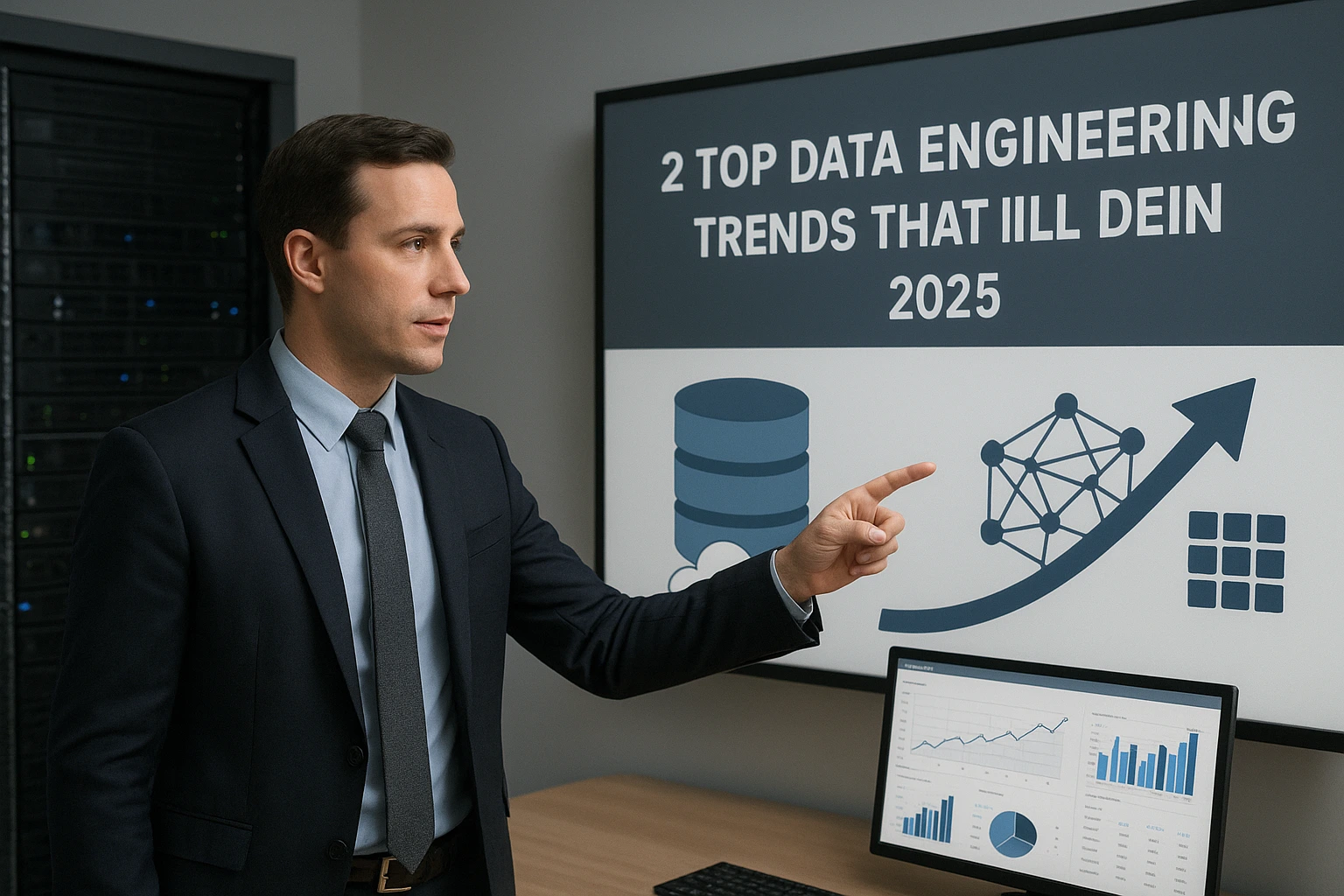
2 Top Data Engineering Trends That Will Define 2025
Stay ahead with the latest data engineering trends for 2025 — from data fabric and real-time pipelines to AI-driven data quality and decentralized architectures.
As data becomes the lifeblood of every modern organization, data engineering has emerged as the silent force behind successful analytics and AI strategies.
In 2025, data teams will focus less on storage and more on connectivity, automation, and intelligence — ensuring that data is clean, reliable, and instantly accessible across the enterprise.
The Rise of the Data Fabric
The concept of a data fabric—an integrated layer connecting disparate data sources across hybrid and multi-cloud environments—will become standard.
It enables seamless access to structured and unstructured data, reducing silos and providing a unified view for analytics, BI, and AI workflows.
By 2025, over 70% of enterprises will deploy a data fabric architecture to support data democratization. — Gartner
Real-Time Data Pipelines and Streaming Analytics
Batch processing is giving way to real-time data streaming.
Using platforms like Kafka, Flink, or Azure Stream Analytics, organizations are enabling instant insight from live data — whether tracking user behavior or monitoring IoT devices.
The result: faster, smarter reactions to market changes and operational anomalies.
AI-Enhanced Data Quality Management
Poor data quality remains a critical barrier to analytics success.
In 2025, AI and ML will automate data cleansing, anomaly detection, and validation — improving accuracy without manual effort.
Self-healing data pipelines will identify and fix issues in real-time, ensuring continuous data integrity.
Decentralized and Edge Data Architectures
With the growth of IoT and 5G, data is being generated closer to where it’s consumed.
Edge computing will play a crucial role in reducing latency and improving performance for time-sensitive applications.
Decentralized data processing also enhances privacy by minimizing data movement across geographies.
The Convergence of DataOps and MLOps
Data engineering teams are increasingly merging with machine learning operations (MLOps) to create a unified data-to-insight pipeline.
This alignment shortens model deployment cycles and ensures better collaboration between data scientists, engineers, and DevOps teams.
Emphasis on Governance, Security, and Compliance
As data privacy regulations expand globally, governance frameworks are no longer optional.
Automated lineage tracking, policy enforcement, and encryption at rest/in transit will be embedded directly into data engineering workflows.
2025 will be the year data engineering evolves from backend support to strategic enablement.
By investing in automation, AI-driven quality, and real-time infrastructure, organizations can transform their data ecosystems into engines of innovation.
To learn how Syntelli Solutions helps enterprises modernize their data architecture, visit syntelli.co and explore our end-to-end Data Engineering & Cloud Services.