
What EPC means in energy projects
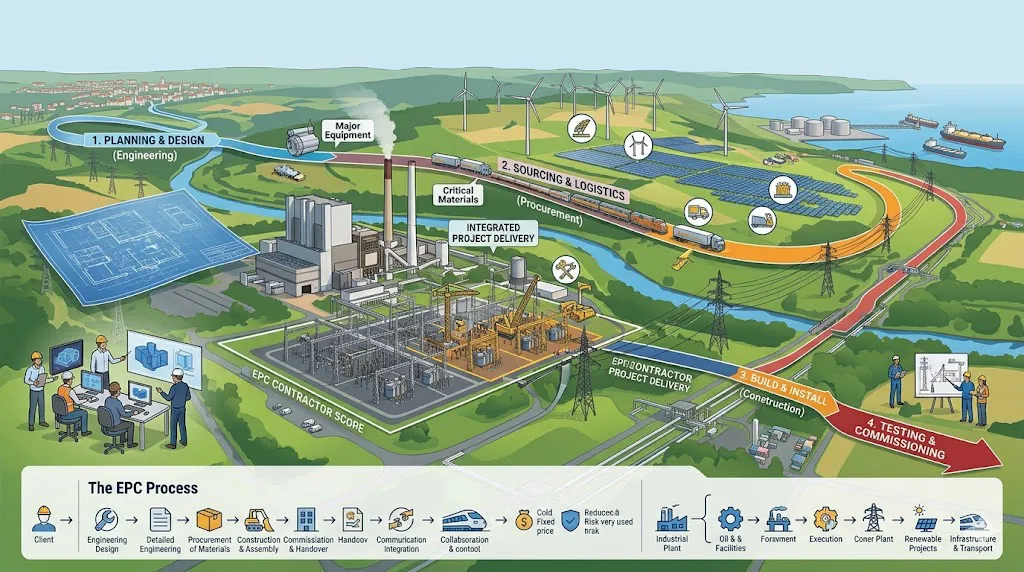
EPC stands for Engineering, Procurement, and Construction. It is a project delivery model widely used in the energy industry where a single contractor is responsible for the entire project lifecycle.
Under an EPC contract, the contractor delivers a fully operational facility. This includes design, equipment supply, construction, and commissioning. The client receives a ready-to-operate project with defined cost and timeline.
The three phases of EPC projects
Engineering phase
This phase defines the technical foundation of the project:
- Concept and detailed design
- System architecture and specifications
- Compliance with safety and regulatory standards
Accurate engineering ensures efficiency, reliability, and cost control.
Procurement phase
All required equipment and materials are sourced:
- Turbines, generators, and major components
- Mechanical and electrical systems
- Supplier selection and contract management
Strong procurement strategy reduces delays and cost overruns.
Construction phase
The physical execution of the project:
- Civil works and infrastructure setup
- Equipment installation
- Electrical and control systems integration
- Testing and commissioning
This phase transforms design into a fully functional energy facility.
Benefits of the EPC model
Single point of responsibility
One contractor manages the entire project, reducing complexity.
Cost certainty
Fixed-price contracts help control budget risks.
Time efficiency
Integrated execution reduces delays between phases.
Reduced client involvement
The contractor handles coordination, allowing the client to focus on strategy.
Better risk allocation
Risks are transferred to the EPC contractor under defined terms.
Common challenges in EPC projects
Cost overruns
Unexpected technical or market changes can increase costs.
Supply chain disruptions
Delays in equipment delivery can impact timelines.
Technical integration issues
Complex systems require precise coordination.
Regulatory delays
Permits and approvals can slow down progress.
Contract management complexity
Clear terms and risk allocation are critical for success.
Examples of large EPC energy projects
Large EPC projects are typically seen in:
- Power plants (combined cycle, renewable, nuclear)
- Oil and gas facilities
- LNG terminals
- Industrial energy infrastructure
These projects often involve multi-billion dollar investments and international collaboration.
Best EPC contractors in the energy industry
Top EPC contractors are known for delivering large-scale projects with efficiency and reliability.
They typically offer:
- End-to-end project delivery
- Advanced engineering capabilities
- Global supply chain networks
- Strong project management systems
The best EPC contractors combine technical expertise with financial and operational strength.
International EPC companies in energy projects
International EPC companies play a major role in global energy development.
They bring:
- Experience across multiple markets
- Access to advanced technologies
- Ability to execute complex, large-scale projects
- Strong financial and operational capacity
These companies are essential for developing infrastructure in emerging and high-growth regions.
EPC projects under Dr Roshandel management
EPC projects under Dr Roshandel management focus on structured execution and risk-controlled delivery.
Core approach:
- Clear project governance
- Strong coordination across all phases
- Focus on timeline and budget control
- Alignment with international standards
This management model supports efficient delivery of complex energy projects.
FAQ
What does EPC stand for?
Engineering, Procurement, and Construction.
What is the difference between EPC and EPCM?
EPC delivers a complete project, while EPCM focuses on management and coordination without full execution responsibility.
Why are EPC contracts common in energy projects?
They reduce complexity, ensure cost control, and provide a single point of responsibility.
About Syntelli
In EPC energy projects, Syntelli focuses on delivering integrated solutions across engineering, procurement, and construction phases. The company emphasizes coordination, cost control, and technical precision to ensure project success. By aligning design, supply chain, and execution strategies, Syntelli supports the development of reliable and scalable energy infrastructure projects in competitive and complex markets.