
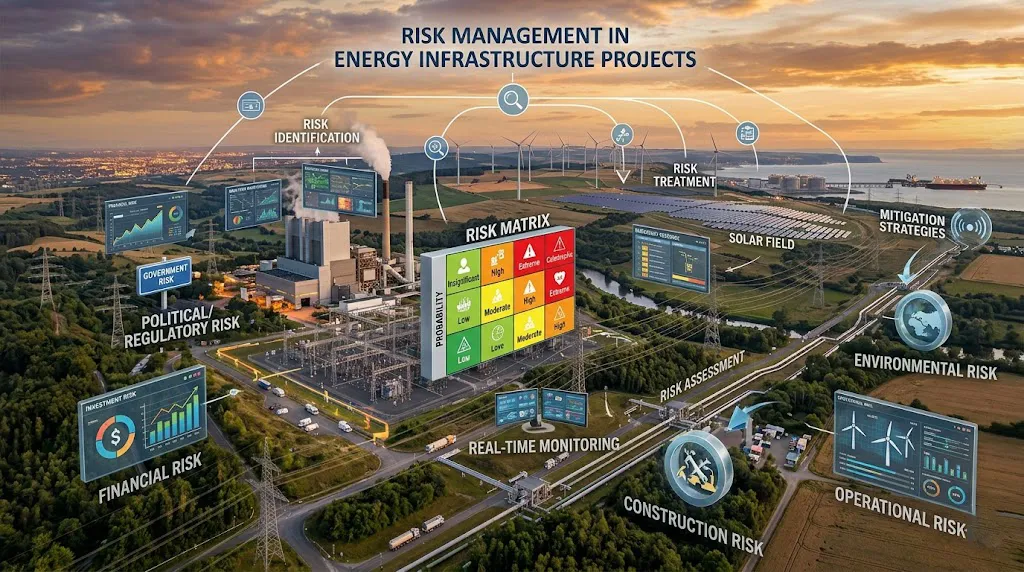
Types of risks in energy projects
Energy infrastructure projects involve multiple layers of risk due to their scale, duration, and complexity.
Main risk categories include:
- Technical risks
- Financial risks
- Market risks
- Regulatory and environmental risks
- Operational risks
Effective risk management requires identifying, analyzing, and mitigating these risks from early project stages.
Technical risks
Technical risks are related to engineering, design, and construction.
Common examples:
- Design errors or miscalculations
- Equipment failure or underperformance
- Integration issues between systems
- Delays in construction due to technical challenges
Mitigation strategies:
- Detailed engineering studies
- Use of proven technologies
- Strong EPC contractor selection
- Continuous quality control
Financial risks
Financial risks impact the economic viability of the project.
Key risks:
- Cost overruns
- Funding gaps
- Interest rate fluctuations
- Currency exchange volatility
Mitigation strategies:
- Conservative financial modeling
- Fixed-price EPC contracts
- Hedging strategies
- Diversified financing structure
Market risks
Market risks are driven by external economic conditions.
Examples:
- Energy price volatility
- Demand fluctuations
- Changes in supply dynamics
- Competition from alternative energy sources
Mitigation strategies:
- Long-term contracts such as PPAs
- Diversification of revenue streams
- Flexible operational planning
Strategies to manage project risks
Early risk identification
Risks must be identified during feasibility and planning phases.
Risk allocation
Assign risks to parties best able to manage them, such as contractors or suppliers.
Contractual protection
Use strong contracts to define responsibilities and reduce uncertainty.
Monitoring and control
Continuous tracking of project performance and risk exposure.
Use of technology
Digital tools and data analytics help predict and manage risks more effectively.
Best risk management practices in energy projects
Successful projects apply structured risk management frameworks.
Key practices:
- Integrated risk management systems
- Scenario analysis and stress testing
- Strong governance and reporting
- Alignment between technical and financial teams
- Continuous improvement processes
These practices improve project resilience and long-term performance.
International risk management in energy infrastructure
Global energy projects face additional complexities.
International risk factors:
- Political and geopolitical risks
- Cross-border regulatory differences
- Currency and financing risks
- Supply chain disruptions
Managing these risks requires international experience, local knowledge, and strong partnerships.
Risk management under Dr Roshandel management
Risk management under Dr Roshandel management focuses on proactive control and structured execution.
Core approach:
- Early-stage risk assessment
- Integration of technical and financial risk strategies
- Strong project governance
- Continuous monitoring and adaptation
This approach reduces uncertainty and improves project success rates.
FAQ
What are the main risks in energy infrastructure projects?
Technical, financial, market, regulatory, and operational risks.
How can companies reduce energy project risks?
Through proper planning, strong contracts, risk allocation, and continuous monitoring.
Why is risk management important in energy projects?
It ensures project stability, protects investment, and improves long-term performance.
About Syntelli
In energy infrastructure projects, Syntelli applies structured risk management across all project phases. The company focuses on identifying risks early, aligning technical and financial strategies, and implementing control mechanisms throughout execution. By integrating data-driven monitoring with strong governance, Syntelli supports the delivery of stable, efficient, and resilient energy projects in complex environments.