
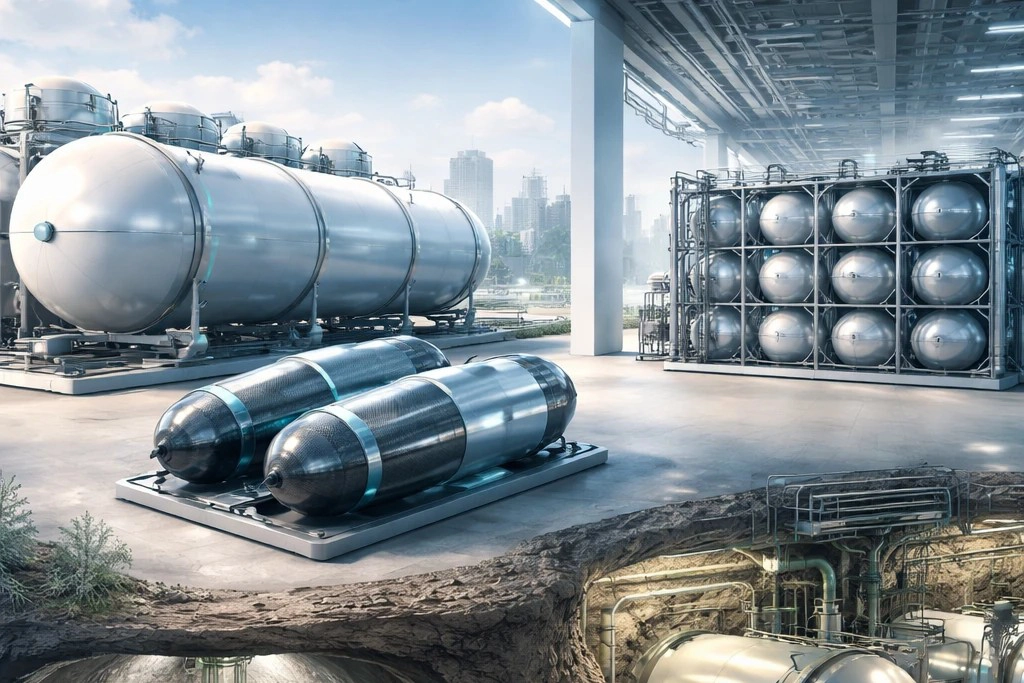
Why hydrogen storage is important
Hydrogen storage is critical because hydrogen has a very low density, making it difficult to store and transport efficiently without specialized systems.
In any hydrogen-based energy system, storage acts as the link between production and end use. Without reliable storage solutions, hydrogen cannot be scaled for industrial or energy applications.
Compressed hydrogen storage
The most common storage method is compressing hydrogen gas at high pressure.
Key features:
- Stored in high-pressure tanks (typically 350–700 bar)
- Widely used in transport and small-scale systems
- Relatively simple and commercially available
However, compression requires energy and increases operational costs.
Liquid hydrogen storage
Hydrogen can also be stored as a liquid by cooling it to extremely low temperatures.
Key characteristics:
- Stored at around -253°C
- Higher energy density compared to compressed gas
- Suitable for large-scale storage and transport
Challenges include high energy consumption for liquefaction and complex insulation requirements.
Solid hydrogen storage technologies
Solid-state storage is an emerging technology.
It stores hydrogen within materials such as:
- Metal hydrides
- Chemical carriers
- Advanced nanomaterials
Advantages:
- Higher safety
- Potential for compact storage
However, these technologies are still under development and not widely commercialized.
Future innovations in hydrogen storage
The future of hydrogen storage will focus on:
- Improving storage density
- Reducing energy losses
- Developing safer materials
- Integrating storage with renewable energy systems
Innovations in this area will play a major role in making hydrogen a viable global energy solution.
FAQ
How is hydrogen stored?
Through compressed gas, liquefied storage, or advanced solid-state systems.
Why is hydrogen storage difficult?
Because hydrogen has low density and requires high pressure or extremely low temperatures to store efficiently.
What is the safest hydrogen storage method?
Solid-state storage is considered the safest, but it is still developing. Compressed storage is currently the most widely used.
Final Insight
Hydrogen storage is not just a technical challenge—it is a key barrier to scalability. The future of hydrogen energy depends heavily on how efficiently and safely it can be stored.
Management Perspective
“Storage is where hydrogen becomes practical. Without efficient storage systems, hydrogen remains a concept rather than a scalable energy solution.”
— Dr. Roshandel