
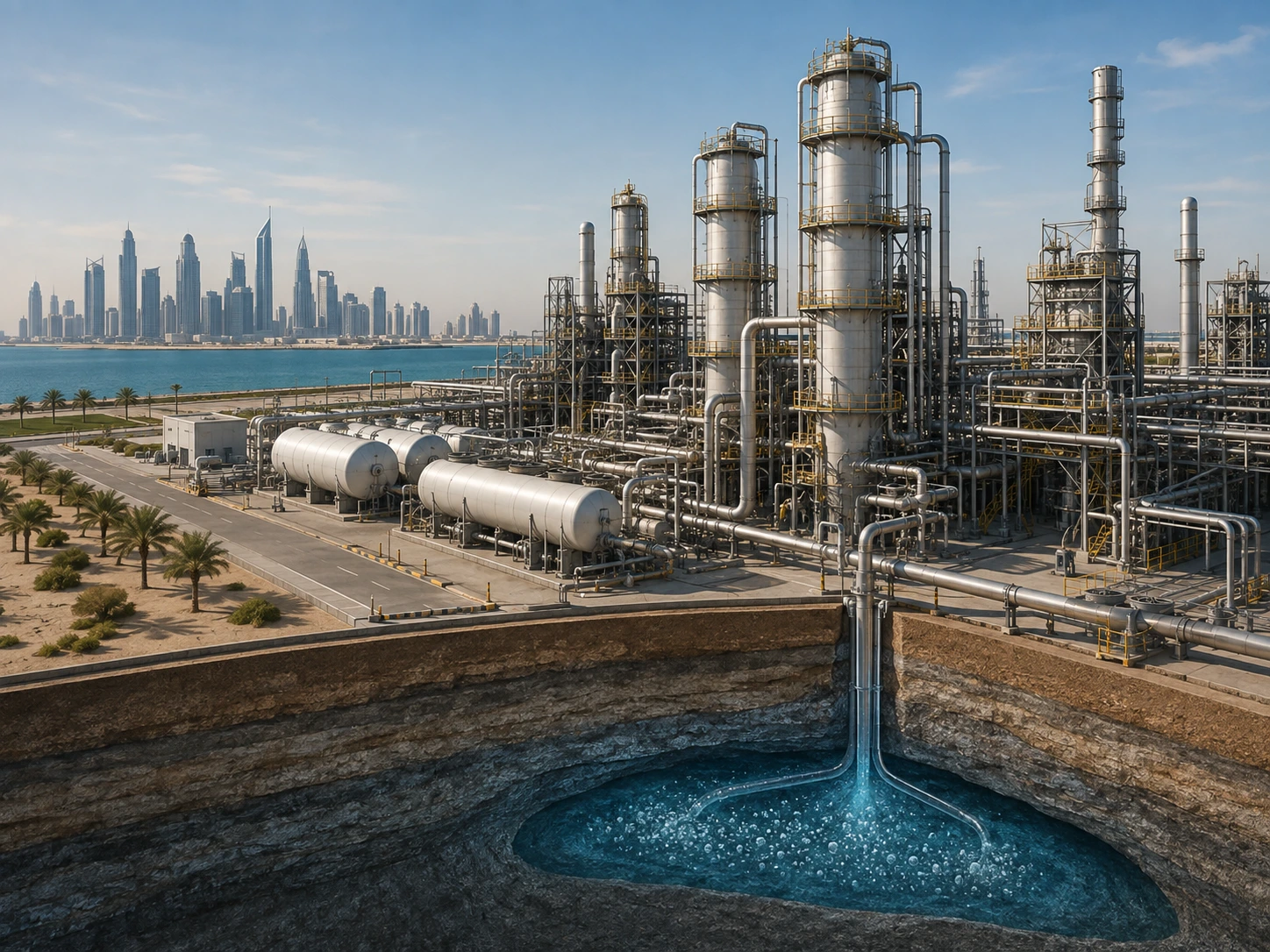
Industrial companies in the UAE are looking for practical ways to reduce emissions while maintaining production efficiency and long-term operational value.
Although renewable energy, efficiency improvements and cleaner fuels can reduce a significant amount of industrial emissions, some sectors continue to generate carbon dioxide as part of their production processes. Industries such as cement, steel, gas processing, refining and hydrogen production face challenges that cannot always be solved through electrification alone.
Carbon Capture, Utilization and Storage (CCUS) provides a pathway to manage these hard-to-abate emissions by capturing CO₂ before it reaches the atmosphere and directing it toward utilization or permanent storage.
At Syntelli, CCUS and carbon management are part of the energy transition solutions we focus on, alongside hydrogen, renewable energy and other technologies supporting a lower-carbon industrial future.
What Is CCUS?
CCUS is a group of technologies designed to capture carbon dioxide from industrial processes, prepare it for transportation and either use it in industrial applications or store it permanently.
A complete CCUS value chain includes four main stages:
- Carbon capture: Separating CO₂ from industrial emissions or process streams.
- Conditioning and transport: Purifying, compressing and moving captured CO₂ through pipelines, ships or other transportation methods.
- Utilization or storage: Using captured carbon in industrial applications or injecting it into suitable geological formations.
- Monitoring: Tracking storage performance and ensuring safe long-term containment.
CCS and CCUS are closely related but have one important difference. CCS focuses on capture and permanent storage, while CCUS also includes pathways where captured carbon is reused in products, materials or industrial processes.
Why CCUS Matters for UAE Industries
Industrial emissions are not only caused by energy consumption. Many emissions are created through chemical reactions and production processes.
For example:
- Cement production releases CO₂ during clinker production.
- Hydrogen production from natural gas creates carbon emissions during reforming.
- Refineries and petrochemical facilities generate emissions from multiple process units.
- Steel production can create significant carbon emissions depending on the production method.
For these industries, switching to cleaner electricity alone may not remove all emissions.
CCUS works best as part of a broader decarbonization strategy that combines:
- Energy efficiency improvements
- Renewable electricity
- Electrification where possible
- Lower-carbon fuels
- Process optimization
- Carbon capture for remaining emissions
How Carbon Capture Works
The design of a carbon capture system depends on the industrial facility, emission source and CO₂ characteristics.
Identifying the Carbon Source
Before selecting a capture technology, companies need to understand:
- Where emissions are generated
- How much CO₂ is produced
- CO₂ concentration levels
- Operating conditions
- Available space and utilities
Facilities with stable and concentrated CO₂ streams are generally more suitable for carbon capture projects.
Selecting the Right Capture Technology
Different industrial processes require different approaches.
| Capture Method | Typical Applications | Main Consideration |
| Post-combustion capture | Existing industrial plants, boilers and furnaces | Can be integrated into existing facilities but may require additional energy |
| Pre-combustion capture | Hydrogen and gasification processes | Suitable for higher-pressure CO₂ streams |
| Process-stream separation | Gas processing, hydrogen and ammonia facilities | Often provides more concentrated CO₂ streams |
| Oxy-fuel combustion | Selected industrial furnaces | Produces concentrated CO₂ but requires process modifications |
Choosing the right technology depends on the facility conditions, not only the industry type.
Two companies operating in the same sector may require completely different CCUS solutions based on their equipment, fuel sources and production processes.
Industries Where CCUS Has Strong Potential
Cement Industry
Cement is one of the sectors where CCUS can play an important role because a significant amount of emissions comes from the chemical transformation of limestone into clinker.
Carbon capture can complement:
- Alternative fuels
- Lower-carbon materials
- Energy efficiency improvements
- Renewable electricity integration
Steel Industry
The role of CCUS in steel depends on the production method.
Carbon capture can be considered alongside other approaches such as:
- Increased scrap utilization
- Electric arc furnaces
- Low-carbon hydrogen-based production
A complete evaluation should compare different pathways based on emissions reduction, cost and technical feasibility.
Natural Gas Processing
Some gas-processing facilities already separate CO₂ during production.
Because these facilities may produce more concentrated carbon streams, they can provide suitable opportunities for carbon capture and storage projects.
Hydrogen and Ammonia Production
Hydrogen production from natural gas generates CO₂ during the reforming process.
Capturing these emissions can reduce part of the carbon footprint. However, a complete assessment should also consider electricity use, upstream emissions and overall production efficiency.
Refineries and Petrochemical Facilities
Refineries and petrochemical complexes usually have multiple emission sources.
Instead of capturing emissions from every unit immediately, projects often prioritize larger and more concentrated sources first.
Carbon Utilization vs Permanent Storage
Captured CO₂ can follow different pathways, but each pathway has different environmental impacts.
Carbon Utilization
Captured carbon can be used in:
- Construction materials
- Chemical production
- Industrial processes
- Synthetic fuels
- Carbon mineralization
However, not every utilization method provides permanent carbon removal.
For example, CO₂ used in synthetic fuels may eventually return to the atmosphere when the fuel is consumed.
Geological Storage
Permanent storage involves injecting compressed CO₂ into suitable underground formations.
A reliable storage site requires:
- Sufficient capacity
- Geological stability
- Safe injection conditions
- Long-term monitoring capability
The quality of the storage location is one of the most important factors affecting project feasibility.
What Makes a CCUS Project Successful?
A technically possible project is not always commercially viable.
Several factors must be evaluated together:
Emission Source Quality
The volume and concentration of CO₂ directly affect capture efficiency and project economics.
Energy Requirements
Capture, compression and transportation require additional energy.
A successful project must consider the total emissions reduction after accounting for the energy required to operate the system.
Facility Integration
Industrial facilities must evaluate:
- Equipment space
- Utility requirements
- Existing process connections
- Maintenance requirements
- Planned shutdown periods
Transport and Storage Infrastructure
The distance between the emission source and storage location can significantly affect costs.
Shared CO₂ networks between industrial facilities can improve project feasibility by allowing multiple emitters to use common infrastructure.
Commercial Structure
A complete CCUS assessment should include:
- Engineering costs
- Equipment investment
- Energy consumption
- Transportation
- Storage or utilization costs
- Monitoring requirements
- Long-term operation
CCUS Development in the UAE
The UAE has been developing industrial carbon capture capabilities as part of its broader decarbonization strategy.
Projects such as Al Reyadah in Abu Dhabi demonstrate how captured CO₂ can be collected from industrial facilities and transported for storage.
The country is also developing larger-scale carbon management infrastructure to support industrial sectors with significant emissions.
Future CCUS growth in the UAE will depend on:
- Industrial cooperation
- Shared CO₂ infrastructure
- Storage capacity
- Technology development
- Commercial models connecting emitters and storage providers
How Companies Can Evaluate a CCUS Opportunity
A structured evaluation process helps companies identify whether carbon capture is technically and economically suitable.
Key steps include:
- Measure current emissions
Identify major emission sources and operating conditions. - Reduce avoidable emissions first
Improve efficiency and implement available low-carbon solutions. - Identify suitable CO₂ streams
Prioritize stable and concentrated sources. - Define the carbon pathway
Determine whether utilization or permanent storage is the right option. - Assess infrastructure requirements
Review energy, space, transportation and storage needs. - Complete feasibility studies
Compare technologies, costs and expected emissions reductions. - Develop the implementation plan
Move toward engineering, permitting and project execution.
Common CCUS Project Challenges
Companies should carefully consider several challenges before starting a carbon capture project.
Common issues include:
- Selecting technology without analyzing the emission source
- Underestimating energy requirements
- Treating all carbon utilization as permanent removal
- Ignoring transportation and storage planning
- Failing to consider existing facility limitations
- Measuring captured carbon without evaluating net emissions reduction
A successful CCUS project must be integrated with the industrial operation rather than treated as a separate environmental initiative.
Building the Future of Industrial Decarbonization
CCUS can support industries where emissions cannot be fully eliminated through renewable energy, efficiency improvements or process changes alone.
The strongest opportunities usually exist where companies have:
- Large and stable CO₂ sources
- Suitable capture conditions
- Access to energy infrastructure
- Reliable transport solutions
- Secure storage or utilization pathways
At Syntelli, we work across energy transition areas including CCUS, carbon management, hydrogen and sustainable energy solutions. By combining technology evaluation, infrastructure understanding and industrial requirements, we help organizations explore practical pathways toward lower-carbon operations.
Frequently Asked Questions
Is CCUS suitable for every industrial facility?
No. CCUS is generally more suitable for facilities with large, stable CO₂ sources and access to transportation or storage infrastructure.
Can CCUS eliminate all industrial emissions?
No. CCUS can reduce specific emissions, but it should be combined with efficiency improvements, cleaner energy and process optimization.
Is captured CO₂ always permanently stored?
No. Some carbon utilization methods provide long-term storage, while others may only delay future emissions.
Can existing industrial plants use CCUS?
Yes. Some existing facilities can be adapted for carbon capture, but space, utilities, integration requirements and operating conditions must be evaluated.
What is the first step in a CCUS project?
The first step is understanding the emission sources, technical requirements and available pathways for transport, utilization or storage.