
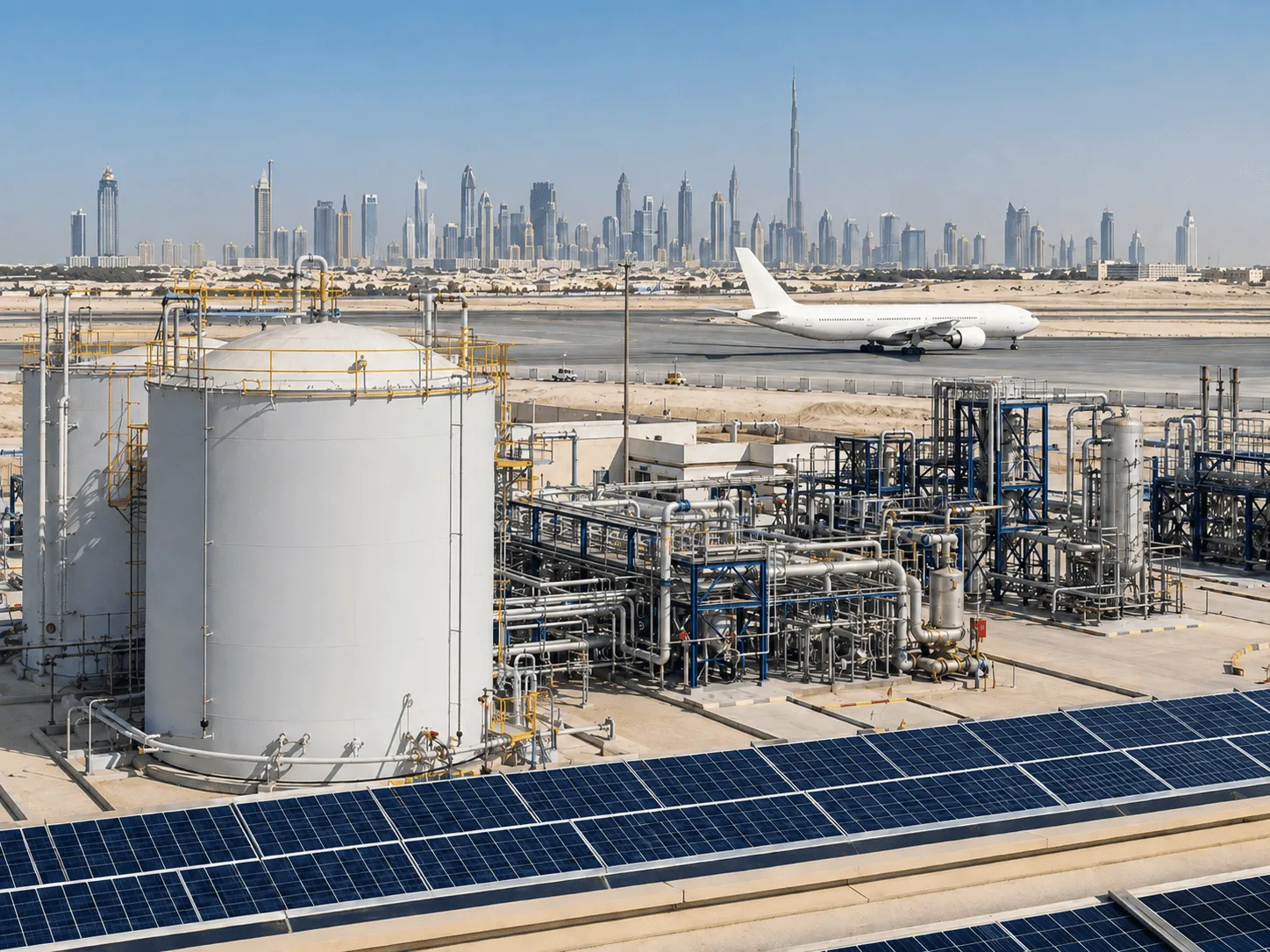
Sustainable aviation fuel, or SAF, is one of the most practical options currently available for reducing aviation emissions without replacing existing aircraft fleets.
Unlike electric or hydrogen-powered aircraft, SAF can be blended with conventional jet fuel and used within existing aviation infrastructure when it meets the required technical standards.
The UAE aims to develop annual SAF production capacity of 700 million litres by 2030. Its national policy also seeks to position the country as a regional hub for low-carbon aviation fuel.
At Syntelli, SAF is part of our Next-Generation Energy Division, alongside clean hydrogen, low-carbon fuels, CCUS and other decarbonization technologies.
What Is Sustainable Aviation Fuel?
SAF is aviation fuel produced from renewable or waste-derived resources that meets defined sustainability requirements.
It is designed to perform like conventional jet fuel while reducing lifecycle emissions associated with fuel production and use.
SAF does not eliminate emissions from an aircraft engine. The main benefit comes from reducing emissions across the complete fuel lifecycle, including:
- Feedstock collection
- Fuel production
- Transport
- Blending
- Final use in aircraft
The actual reduction depends on the feedstock, production method and energy used throughout the supply chain.
How Is SAF Different from Conventional Jet Fuel?
Conventional jet fuel is produced from crude oil. SAF can be produced from waste oils, agricultural residues, municipal waste, alcohols or renewable electricity combined with hydrogen and captured carbon.
Both fuels must meet strict aviation requirements for factors such as:
- Energy content
- Freezing point
- Thermal stability
- Density
- Combustion performance
- Storage compatibility
SAF is generally blended with conventional jet fuel before delivery to an airport. The permitted blending ratio depends on the approved production pathway and applicable fuel specification.
Main SAF Production Pathways
There is no single method for producing sustainable aviation fuel. The correct pathway depends on available feedstocks, energy costs, infrastructure and the target market.
| Production pathway | Main feedstock | Main consideration |
| HEFA | Used cooking oil, waste fats and vegetable oils | Commercially established but dependent on limited waste-oil supply |
| Alcohol-to-Jet | Ethanol or other alcohols | Requires reliable low-carbon alcohol production |
| Fischer-Tropsch | Municipal waste, biomass or synthesis gas | Can use different waste streams but requires complex processing |
| Power-to-Liquid | Green hydrogen and captured CO₂ | Offers strong long-term potential but requires large amounts of renewable power |
HEFA
Hydroprocessed Esters and Fatty Acids, known as HEFA, converts oils and fats into aviation fuel.
Potential feedstocks include:
- Used cooking oil
- Waste animal fats
- Industrial oil residues
- Selected vegetable oils
HEFA is one of the more commercially developed SAF pathways. Its main limitation is feedstock availability.
A project must confirm that waste oils can be collected consistently and traced without creating pressure on food production or encouraging unsustainable land use.
Alcohol-to-Jet
Alcohol-to-Jet converts alcohols such as ethanol into jet fuel through several chemical processing stages.
The sustainability of the final fuel depends heavily on how the alcohol is produced. Ethanol made with high fossil-energy consumption may provide less lifecycle benefit than alcohol produced from waste, residues or low-carbon energy.
This pathway requires a dependable alcohol supply, suitable conversion facilities and clear sustainability certification.
Fischer-Tropsch
The Fischer-Tropsch pathway converts synthesis gas into liquid fuel.
The synthesis gas can be produced from:
- Municipal solid waste
- Agricultural residues
- Forestry residues
- Biomass
- Other carbon-containing materials
This route can help turn waste into aviation fuel, but the facility is technically complex. Feedstock sorting, gasification, gas cleaning and fuel upgrading must all work as one integrated system.
Power-to-Liquid
Power-to-Liquid SAF, also called e-SAF, is produced using green hydrogen and captured carbon dioxide.
Renewable electricity powers electrolysis to produce hydrogen. The hydrogen is then combined with CO₂ to create synthetic fuel.
This pathway could be relevant to the UAE because of the country’s renewable-energy and hydrogen ambitions. However, e-SAF requires:
- Large amounts of clean electricity
- Reliable green hydrogen production
- A suitable source of captured CO₂
- Complex fuel-synthesis facilities
- Long-term buyers willing to support project economics
The source of electricity is critical. If the process depends heavily on high-carbon power, the final fuel may deliver a weaker emissions benefit.
Which Feedstocks Are Suitable for the UAE?
A SAF project should not begin by choosing a technology. It should begin with a realistic assessment of local and imported feedstocks.
Potential options include:
- Used cooking oil
- Waste fats
- Municipal solid waste
- Agricultural residues
- Low-carbon ethanol
- Captured industrial or biogenic CO₂
- Green hydrogen
Each feedstock creates a different supply chain.
Used cooking oil requires collection, cleaning and traceability. Municipal waste requires sorting and stable composition. E-SAF requires continuous renewable power, hydrogen and carbon supply.
The best pathway is not necessarily the one with the most advanced technology. It is the one that can secure suitable feedstock at the required quality, volume and price.
What Makes a SAF Project Commercially Viable?
SAF projects are affected by more than production technology.
Feedstock Security
The plant needs a stable supply over its full operating life.
A feasibility study should examine:
- Annual feedstock volume
- Seasonal changes
- Competing demand
- Collection costs
- Import requirements
- Quality variation
- Sustainability risks
A facility cannot operate reliably if its feedstock is available only during certain periods or becomes too expensive after construction.
Energy Requirements
SAF production can require hydrogen, heat, electricity and steam.
The cost and carbon intensity of these inputs affect both production economics and lifecycle emissions.
Plant Location
The site should provide practical access to:
- Feedstock
- Utilities
- Storage
- Transport networks
- Refineries or blending facilities
- Airports or fuel terminals
A low-cost production site may lose its advantage if the fuel must travel through a long and complex logistics chain.
Offtake Agreements
SAF is generally more expensive to produce than conventional jet fuel.
Long-term offtake agreements with airlines, fuel suppliers or airport operators can reduce demand risk and support project financing.
These agreements should define:
- Required annual volume
- Delivery location
- Fuel specification
- Pricing structure
- Certification requirements
- Contract duration
Certification and Traceability
A fuel should not be called sustainable only because it is made from a renewable resource.
The producer must document the feedstock origin, production process and lifecycle emissions. Under CORSIA, eligible fuels must come from producers certified through an ICAO-approved sustainability certification scheme.
Traceability is important from feedstock collection to final fuel delivery.
How SAF Reaches an Aircraft
Producing SAF is only one part of the value chain.
The complete delivery process normally includes:
- Feedstock collection or production
- Feedstock preparation
- Conversion into synthetic aviation fuel
- Fuel testing and certification
- Blending with conventional jet fuel
- Transport to a fuel terminal or airport
- Storage and delivery into the airport fuel system
SAF can often use existing storage and fuel-delivery infrastructure after it has been certified and blended correctly.
However, the project must define responsibilities across producers, fuel traders, blending facilities, airports and airlines.
How Much Can SAF Reduce Aviation Emissions?
The environmental performance of SAF should be measured across its lifecycle.
Two fuels produced through the same pathway can have different results because of differences in feedstock, electricity source, transportation and processing efficiency.
The assessment should include:
- Direct production emissions
- Electricity and heat consumption
- Feedstock cultivation or collection
- Land-use effects
- Hydrogen production
- Fuel transportation
- Co-products and waste
- Final combustion
ICAO defines SAF as renewable or waste-derived aviation fuel that meets sustainability criteria and uses lifecycle methodologies under CORSIA.
This is why verified lifecycle data is more important than broad claims about a fuel being “green.”
Opportunities for SAF Production in the UAE
The UAE has several advantages for developing a SAF industry:
- Major international airports
- Large national airlines
- Existing fuel and logistics infrastructure
- Renewable-energy development
- Growing hydrogen capabilities
- Access to regional and global markets
The national production target can create opportunities for fuel producers, technology providers, investors, airlines, airports and feedstock suppliers.
However, successful projects still require clear answers to four questions:
- Which feedstock will be used?
- Which production pathway is suitable?
- Who will purchase the fuel?
- How will certification and delivery be managed?
Without these elements, a project may remain technically interesting but commercially incomplete.
How to Evaluate a SAF Production Project
A practical evaluation should follow this sequence:
1. Identify the Target Market
Determine whether the fuel will be supplied to UAE airlines, international buyers or both.
2. Secure the Feedstock
Confirm volume, quality, price and long-term availability.
3. Select the Production Pathway
Compare technologies based on feedstock and local operating conditions.
4. Calculate Lifecycle Emissions
Measure the complete emissions profile rather than only plant operations.
5. Plan Certification
Identify the technical and sustainability standards required by the target buyer.
6. Design the Supply Chain
Define blending, storage, transportation and airport delivery requirements.
7. Secure Offtake
Develop commercial agreements before making the final investment decision.
8. Complete Engineering and Financing
Move from feasibility to detailed design, permitting and project execution.
Common SAF Project Mistakes
Common planning mistakes include:
- Selecting a technology before securing feedstock
- Assuming every biofuel qualifies as SAF
- Ignoring lifecycle emissions
- Underestimating hydrogen and electricity demand
- Delaying certification planning
- Building production capacity without an offtake agreement
- Ignoring blending and airport-delivery requirements
- Depending on a single uncertain feedstock source
A viable SAF project must connect production, certification, logistics and demand from the beginning.
Developing SAF Opportunities with Syntelli
SAF projects require coordination between energy production, feedstock supply, fuel conversion, infrastructure and aviation customers.
At Syntelli, sustainable aviation fuel is part of our Next-Generation Energy Division. Our work across biofuels, e-fuels, hydrogen, low-carbon products and energy infrastructure supports a broader approach to aviation decarbonization.
We evaluate SAF opportunities within the complete energy value chain rather than treating fuel production as an isolated process.
Discuss a Sustainable Aviation Fuel Opportunity
Before choosing a technology, a SAF project needs a clear feedstock strategy, production pathway, certification plan and target buyer.
Contact Syntelli to discuss SAF production, low-carbon fuel development and the infrastructure required to move a project from early assessment toward implementation.
Frequently Asked Questions
Can SAF be used in existing aircraft?
Certified SAF blends can be used in existing aircraft and fuel infrastructure when they meet the applicable aviation-fuel standards.
Is SAF completely carbon-free?
No. SAF still produces CO₂ during combustion. Its benefit is based on lower verified lifecycle emissions compared with conventional jet fuel.
What is the most common SAF feedstock?
Used oils and waste fats are widely used in current production, but supply is limited. Other pathways use alcohol, waste, biomass, hydrogen and captured CO₂.
Is e-SAF the same as biofuel?
No. E-SAF is produced using renewable electricity, hydrogen and captured carbon. Bio-based SAF is produced from biological feedstocks or waste materials.
What is the first step in a SAF project?
The first step is confirming the target market and feedstock supply. Technology should be selected only after these two points are understood.