
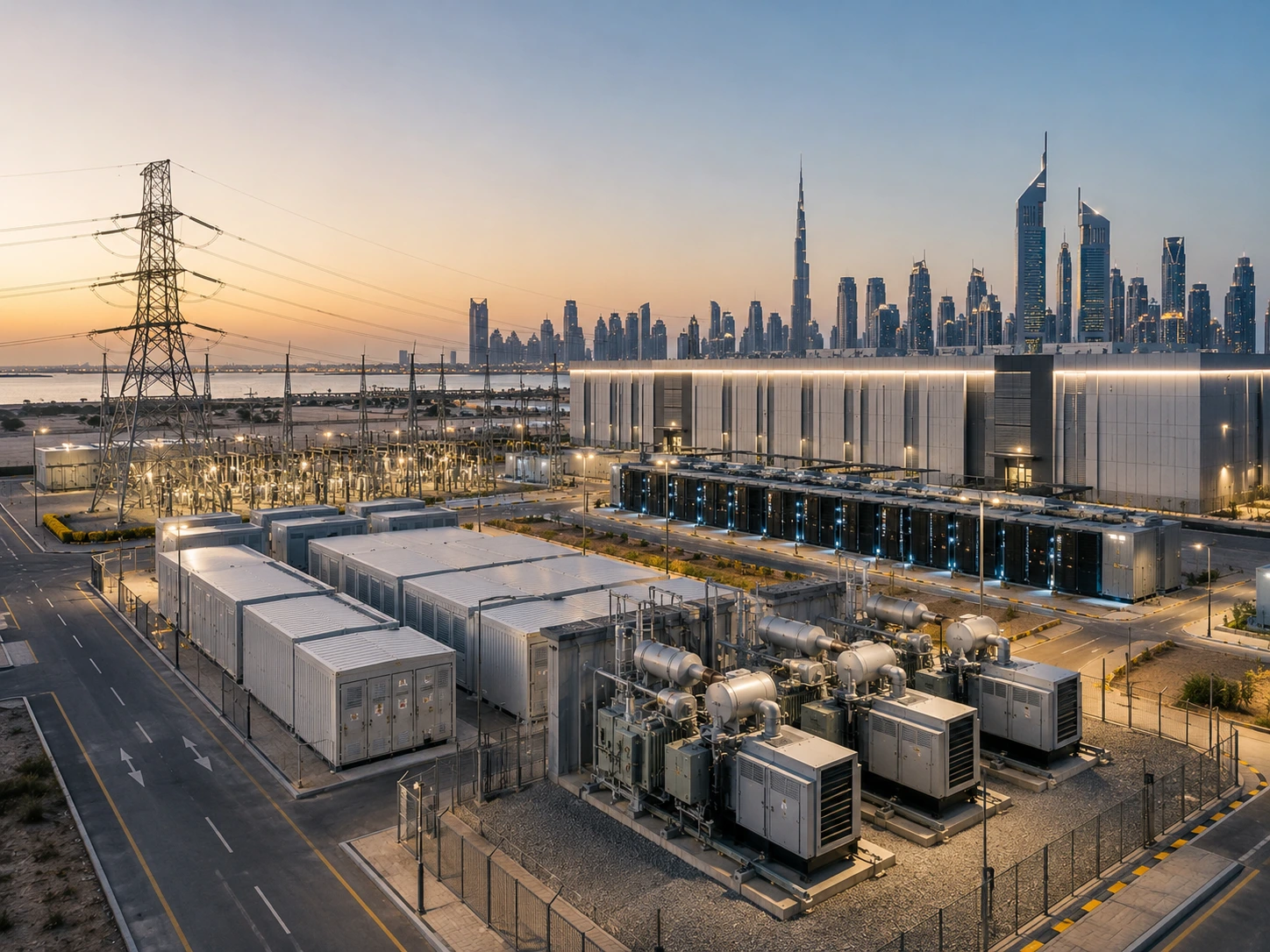
AI data centers require more than a large electricity connection. Their power infrastructure must support high-density computing, continuous operation, cooling systems, backup capacity and future expansion without creating a single point of failure.
This requirement is becoming increasingly important in the UAE as investment in artificial intelligence and digital infrastructure grows. The 5-gigawatt UAE–US AI Campus announced in Abu Dhabi shows the scale at which future AI infrastructure is being planned. Globally, the International Energy Agency expects data center electricity consumption to reach around 945 TWh by 2030, more than double its 2024 level.
At Syntelli, data centers are one of our focus industries. Our portfolio includes generators, control systems, fuel cells, power generation solutions and low- and medium-voltage distribution products that are relevant to reliable energy infrastructure.
Why AI Data Centers Need a Different Power Strategy
Traditional enterprise data centers usually operate with relatively predictable server loads. AI facilities can have much higher rack densities and more demanding load patterns because they use large numbers of GPUs and other high-performance processors.
AI training workloads may run continuously for long periods and place significant demand on both computing and cooling infrastructure. Power demand can also change quickly when new workloads start, stop or move between computing clusters.
The power system must therefore manage:
- High and concentrated electrical loads
- Rapid changes in computing demand
- Continuous cooling requirements
- Strict limits on downtime
- Future expansion of server capacity
- Power quality for sensitive equipment
- Higher energy and operating costs
A data center that has enough total electricity but lacks redundancy, monitoring or distribution capacity can still experience serious operational problems.
Main Components of AI Data Center Power Infrastructure
A complete power system connects the utility grid to the computing equipment through several protection, conversion and backup layers.
| Infrastructure component | Main role |
| Utility grid connection | Supplies the main electrical load |
| High- and medium-voltage equipment | Receives and distributes power across the site |
| Transformers | Convert voltage to the required operating levels |
| Switchgear | Controls, isolates and protects electrical circuits |
| UPS systems | Provide immediate short-term power during an interruption |
| Battery systems | Support the UPS and bridge the gap before backup generation starts |
| Backup generators | Maintain operation during longer grid outages |
| Power distribution units | Deliver electricity to server racks and IT equipment |
| Control and monitoring systems | Track load, power quality, equipment status and faults |
| Cooling power infrastructure | Supplies chillers, pumps, fans and liquid-cooling systems |
These components must be designed as one coordinated system. Increasing the capacity of one section does not solve a bottleneck elsewhere in the power chain.
Utility Connection and Site Power Capacity
The first major question in a UAE data center project is whether the selected site can receive enough power at the required time.
Developers need to confirm:
- Available grid capacity
- Connection voltage
- Substation requirements
- Connection lead time
- Initial operational load
- Future expansion capacity
- Utility connection costs
- Required technical approvals
The total planned IT load should not be confused with the electricity required by the whole facility. Cooling, lighting, pumps, security systems, network equipment and electrical losses also consume power.
A 50 MW computing load therefore requires more than a 50 MW utility connection.
Site selection and power planning should happen together. Choosing land before confirming the electrical connection can lead to delays, additional infrastructure costs or restrictions on future expansion.
Understanding Power Redundancy
Redundancy determines whether the facility can continue operating when equipment fails or requires maintenance.
The correct configuration depends on the importance of the workload, required availability and project budget.
N Configuration
An N configuration provides only the capacity required to operate the facility.
For example, if four UPS modules are needed to support the load, the system contains four modules. If one fails, the remaining equipment may not have enough capacity.
This configuration has lower initial cost but limited fault tolerance.
N+1 Configuration
An N+1 system includes one additional component beyond the minimum requirement.
If four generators are needed, the facility installs five. One unit can fail or undergo maintenance while the remaining units continue supporting the load.
N+1 is commonly used where some redundancy is required without fully duplicating the system.
2N Configuration
A 2N configuration provides two independent power paths, each capable of supporting the full load.
If one path becomes unavailable, the second path can continue supplying the facility. This model provides greater resilience but requires more equipment, space and investment.
Choosing the Right Redundancy Level
The decision should consider:
- Business impact of downtime
- Workload criticality
- Maintenance requirements
- Failure scenarios
- Available project budget
- Space and equipment limitations
- Future capacity plans
More redundancy is not automatically better. The selected design must provide the required reliability without creating unnecessary complexity and cost.
UPS Systems, Batteries and Backup Generation
UPS systems and backup generators perform different functions.
A UPS responds immediately when the main power source is interrupted. It protects sensitive IT equipment and maintains operation while the backup generation system starts.
Backup generators are designed to support longer interruptions.
A complete backup strategy should define:
- UPS runtime
- Battery technology
- Generator starting time
- Generator load acceptance
- Fuel storage capacity
- Refuelling arrangements
- Maintenance schedules
- Testing under real load
- Failure response procedures
The backup system must support more than the servers. Cooling, pumps, network infrastructure, control systems and safety equipment may also need emergency power.
If backup capacity is calculated only from the IT load, the facility may be unable to maintain safe operating temperatures during a grid outage.
Power Distribution Inside the Data Center
After electricity enters the site, it must be distributed efficiently and safely to every rack.
The internal network usually includes transformers, switchgear, busways, distribution boards and rack-level power distribution units.
The design should address:
- Maximum rack density
- Cable and busway capacity
- Voltage levels
- Circuit protection
- Power path separation
- Harmonic distortion
- Phase balancing
- Metering at different levels
- Maintenance access
AI racks may require significantly more power than conventional server racks. A distribution system designed around lower rack densities can become the main limitation when the facility upgrades its computing hardware.
For this reason, developers should plan for realistic future density rather than only the equipment installed during the first phase.
Cooling Is Part of the Power Infrastructure
Most electricity entering a data center eventually becomes heat. As computing density rises, the cooling system becomes a major part of both electrical planning and operational reliability.
Traditional air cooling may remain suitable for lower-density areas. High-density AI clusters may require more advanced approaches such as:
- Direct-to-chip liquid cooling
- Rear-door heat exchangers
- Immersion cooling
- Chilled-water systems
- Hybrid air and liquid cooling
The UAE climate adds another challenge. High outdoor temperatures increase cooling demand and can reduce the efficiency or available output of some electrical and mechanical equipment.
Cooling systems should therefore be evaluated for local design conditions, not only average annual temperatures.
The power design must include:
- Cooling load during peak summer conditions
- Redundant pumps and cooling equipment
- Emergency cooling requirements
- Water availability
- Heat rejection capacity
- Cooling-system restart after an outage
- Power required during backup operation
A reliable server power system is not enough if the cooling system cannot continue operating during an interruption.
Measuring Data Center Energy Efficiency
Power Usage Effectiveness, or PUE, is one of the most common data center efficiency metrics.
It compares the total electricity used by the facility with the electricity delivered to IT equipment.
A PUE closer to 1 indicates that a larger share of the facility’s electricity is reaching servers rather than being consumed by cooling, lighting and supporting systems.
PUE should not be treated as the only performance measure. It can change with:
- Outdoor temperature
- Computing utilization
- Cooling design
- Facility size
- Measurement boundaries
- Seasonal operating conditions
A very low PUE does not automatically mean the data center has low total energy consumption. A large AI facility can be highly efficient and still use a significant amount of electricity.
Useful performance indicators may also include:
- Energy use per computing workload
- Cooling-system efficiency
- Renewable energy share
- Carbon emissions per unit of electricity
- Water consumption
- UPS and transformer losses
- Unused electrical capacity
Renewable Energy for UAE Data Centers
Solar power can reduce the carbon intensity of data center operations in the UAE, but solar generation does not match the continuous load profile of a 24-hour facility.
A data center cannot rely only on the amount of renewable electricity generated over a year. It must also consider when that electricity is available and how the facility will operate when solar output falls.
Renewable energy strategies may include:
- On-site solar generation
- Utility renewable energy programmes
- Power purchase agreements
- Renewable energy certificates
- Battery energy storage
- A mixed supply from grid and on-site generation
The UAE already has examples of data centers powered through renewable energy arrangements, including Moro Hub’s green data center at the Mohammed bin Rashid Al Maktoum Solar Park.
The correct solution depends on the facility load, available land, grid structure and sustainability targets.
Can Battery Storage Replace Backup Generators?
Battery storage can support several data center functions:
- Immediate backup power
- Peak-load management
- Renewable energy integration
- Power-quality support
- Reduced generator operation
- Participation in demand-management programmes
However, batteries do not automatically replace generators.
The required storage duration depends on grid reliability, outage scenarios and the time needed to restore the main supply. Providing several hours of backup for a large AI data center may require a substantial battery system.
A hybrid design may use UPS batteries for immediate response, larger battery storage for short- to medium-duration support and generators or another dispatchable source for longer outages.
The decision should be based on a complete reliability and cost assessment rather than selecting one technology for every backup function.
Microgrids and On-Site Power Generation
Large AI data centers can place enough load on the grid to justify evaluating a microgrid or dedicated on-site generation.
A microgrid can combine:
- Utility power
- Solar generation
- Battery storage
- Gas-based generation
- Fuel cells
- Backup generators
- Automated control systems
The main benefit is not complete independence from the utility grid. It is the ability to coordinate several energy sources and maintain critical loads during defined operating conditions.
On-site generation may also support phased development when the required grid capacity cannot be delivered immediately.
However, the project must evaluate fuel supply, emissions, maintenance, noise, space, permitting and operating costs before choosing a dedicated generation system.
Power Monitoring and Intelligent Control
AI data centers need real-time visibility across the entire power chain.
Monitoring should cover:
- Utility connection status
- Transformer loading
- UPS performance
- Battery condition
- Generator readiness
- Rack-level power consumption
- Cooling-system load
- Power quality
- Equipment temperature
- Fault and alarm history
Advanced controls can identify abnormal consumption, shift flexible loads, coordinate generators and batteries and support predictive maintenance.
The UAE Ministry of Energy and Infrastructure has also begun examining how AI-based control can improve energy efficiency in data centers, including a 2026 pilot involving Khazna Data Centers and Agility.
Automation does not remove the need for engineering redundancy. It helps operators use the installed infrastructure more effectively and detect problems before they lead to downtime.
How to Plan Power Infrastructure for an AI Data Center
A practical planning process should follow the real development sequence.
1. Define the Computing Load
Estimate the initial IT capacity, rack density, operating profile and expected future expansion.
2. Calculate the Total Facility Load
Add cooling, electrical losses, lighting, security, networks and other supporting systems.
3. Confirm Grid Availability
Verify connection capacity, voltage, timeline, approvals and expansion options with the relevant utility.
4. Set the Availability Requirement
Determine the acceptable downtime and select the appropriate redundancy configuration.
5. Design the Primary Power Path
Define transformers, switchgear, distribution equipment and rack-level delivery.
6. Design Backup Power
Coordinate UPS systems, batteries, generators, fuel supply and emergency cooling.
7. Integrate Cooling and Power Planning
Evaluate cooling demand at both normal and peak UAE temperatures.
8. Assess Renewable and On-Site Generation
Compare available energy sources based on reliability, cost and carbon impact.
9. Build for Expansion
Reserve practical space and capacity for future power modules, cooling equipment and higher-density racks.
10. Test the Complete System
Commissioning should test individual equipment and full operating scenarios, including grid loss, generator start, battery transfer and cooling continuity.
Common Power Infrastructure Mistakes
Several mistakes can create expensive limitations after the data center begins operating:
- Selecting a site before confirming power availability
- Calculating only the IT load
- Underestimating cooling demand
- Designing for current rack density only
- Adding backup generators without protecting the cooling system
- Installing redundant equipment with shared failure points
- Ignoring fuel supply during extended outages
- Treating annual renewable generation as continuous power availability
- Failing to test the complete power chain
- Delaying expansion planning until the first phase is full
The most reliable design is not simply the one with the most equipment. It is the one in which every power path, control system and backup layer works together.
Building Reliable AI Data Center Power Infrastructure with Syntelli
AI data center projects require coordinated decisions across generation, electrical distribution, automation, backup power and long-term energy planning.
At Syntelli, data centers are part of our industrial focus. Our power and hardware portfolio includes generators, control systems, fuel cells, energy-saving devices and low- and medium-voltage distribution products. We also work across wider power generation and next-generation energy infrastructure.
This combination allows power requirements to be evaluated as a complete infrastructure system rather than as separate equipment purchases.
Discuss Your Data Center Power Requirements
Before selecting equipment, the project must define its computing load, grid conditions, redundancy target, cooling requirements and expansion plan.
Contact Syntelli to discuss the power infrastructure requirements of your AI or high-density data center project and identify the most relevant energy, distribution and control solutions.
Frequently Asked Questions
How much power does an AI data center need?
The requirement depends on the number and type of processors, rack density, cooling system and facility size. The total site load will be higher than the IT load because supporting infrastructure also consumes electricity.
What is the difference between UPS and generator backup?
A UPS provides immediate short-term power when the main supply is interrupted. A generator starts shortly afterwards and supports the facility during a longer outage.
Is N+1 redundancy enough for an AI data center?
It may be suitable for some facilities, but critical workloads may require independent 2N power paths. The correct configuration depends on the acceptable downtime and business impact of failure.
Can solar power run an AI data center in the UAE?
Solar power can supply part of the energy demand and reduce carbon intensity, but a continuously operating facility also needs reliable power when solar generation is unavailable.
Why must cooling be included in backup-power planning?
Servers continue producing heat during an outage. If cooling loses power while the IT equipment remains active, temperatures can rise quickly and force an emergency shutdown.
What should be checked before choosing a data center site?
Developers should confirm grid capacity, connection timeline, expansion potential, cooling conditions, telecommunications access, land requirements and the cost of supporting infrastructure.