
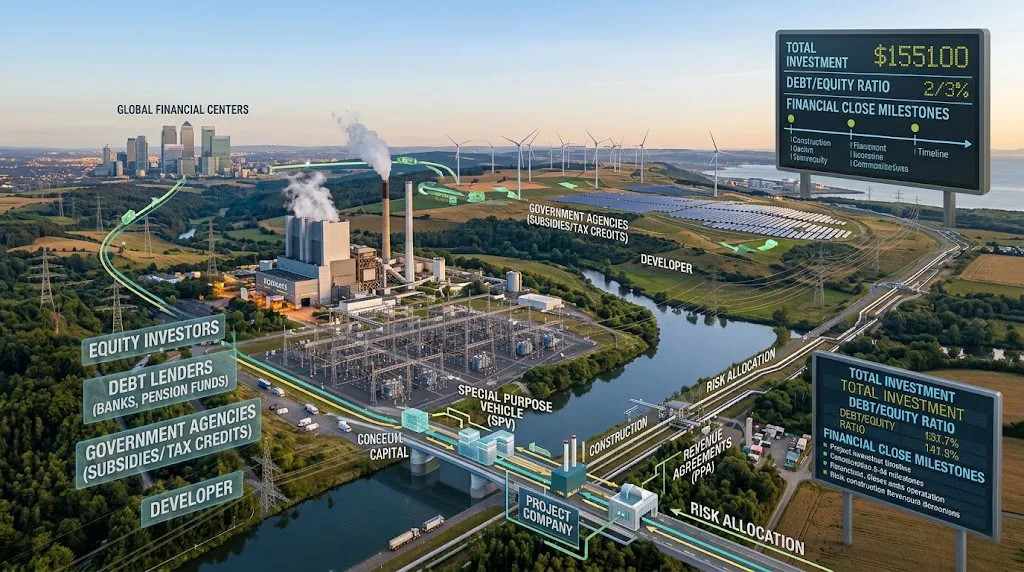
Why energy projects require large investments
Energy infrastructure projects are capital-intensive due to their scale, complexity, and long lifecycle.
Key cost drivers include:
- Construction of large facilities such as power plants and refineries
- Advanced equipment and technology
- Land acquisition and permitting
- Grid connection and infrastructure integration
These projects often require billions of dollars and long-term financial planning before generating returns.
What project finance means
Project finance is a structured financing method where the project itself is the primary source of repayment.
Instead of relying on the balance sheet of sponsors, lenders evaluate:
- Project cash flow
- Long-term contracts (such as power purchase agreements)
- Risk allocation among stakeholders
This model is widely used in energy infrastructure because it allows large projects to be funded with limited recourse to sponsors.
Main sources of funding for energy projects
Equity investment
Sponsors and investors provide capital in exchange for ownership and returns.
Debt financing
Banks and financial institutions provide loans based on project viability.
Government support
Includes subsidies, guarantees, and public funding for strategic projects.
Multilateral institutions
Development banks finance projects in emerging markets.
Private investors
Institutional investors participate in large-scale infrastructure projects.
A balanced financing structure is critical for project success.
Financial risks in energy infrastructure
Cost overruns
Unexpected increases in construction or equipment costs.
Revenue uncertainty
Fluctuations in energy prices and demand.
Currency risk
Projects in international markets face exchange rate volatility.
Interest rate risk
Changes in financing costs over time.
Regulatory risk
Policy changes can impact project profitability.
Managing these risks is essential to secure funding and ensure long-term stability.
The role of investors and banks
Investors and banks play a central role in energy project development.
Investors
- Provide equity capital
- Expect long-term returns
- Focus on risk-adjusted performance
Banks and lenders
- Provide structured debt
- Assess project feasibility
- Monitor financial performance
Their involvement ensures financial discipline and project accountability.
Best energy project financing strategies
Successful energy projects rely on strong financial structuring.
Key strategies include:
- Long-term power purchase agreements (PPAs)
- Diversified funding sources
- Risk-sharing mechanisms
- Strong contractual frameworks
- Conservative financial modeling
These strategies improve bankability and investor confidence.
International financing for energy infrastructure
International financing is essential for large-scale projects, especially in developing markets.
Benefits include:
- Access to global capital
- Competitive financing terms
- Risk diversification
- Support from international financial institutions
Cross-border financing enables projects that would otherwise be difficult to fund locally.
Energy investments under Dr Roshandel management
Energy investment strategies under Dr Roshandel management focus on sustainable growth and risk-controlled returns.
Key principles:
- Careful project selection
- Balanced capital structure
- Focus on long-term cash flow stability
- Alignment with international investment standards
This approach enhances project bankability and financial performance.
FAQ
What is project finance?
A financing method where a project is funded based on its expected cash flow rather than the sponsor’s balance sheet.
Who finances power plant projects?
Banks, institutional investors, governments, and development finance institutions.
How do investors make money from energy infrastructure?
Through long-term returns generated by stable cash flows, often backed by contracts such as PPAs.
About Syntelli
In energy project financing, Syntelli focuses on structuring investments that align technical execution with financial sustainability. The company approaches financing by integrating project design, risk management, and capital strategy from early stages. By combining engineering insight with financial planning, Syntelli supports the development of bankable energy projects with stable long-term returns across different markets.