
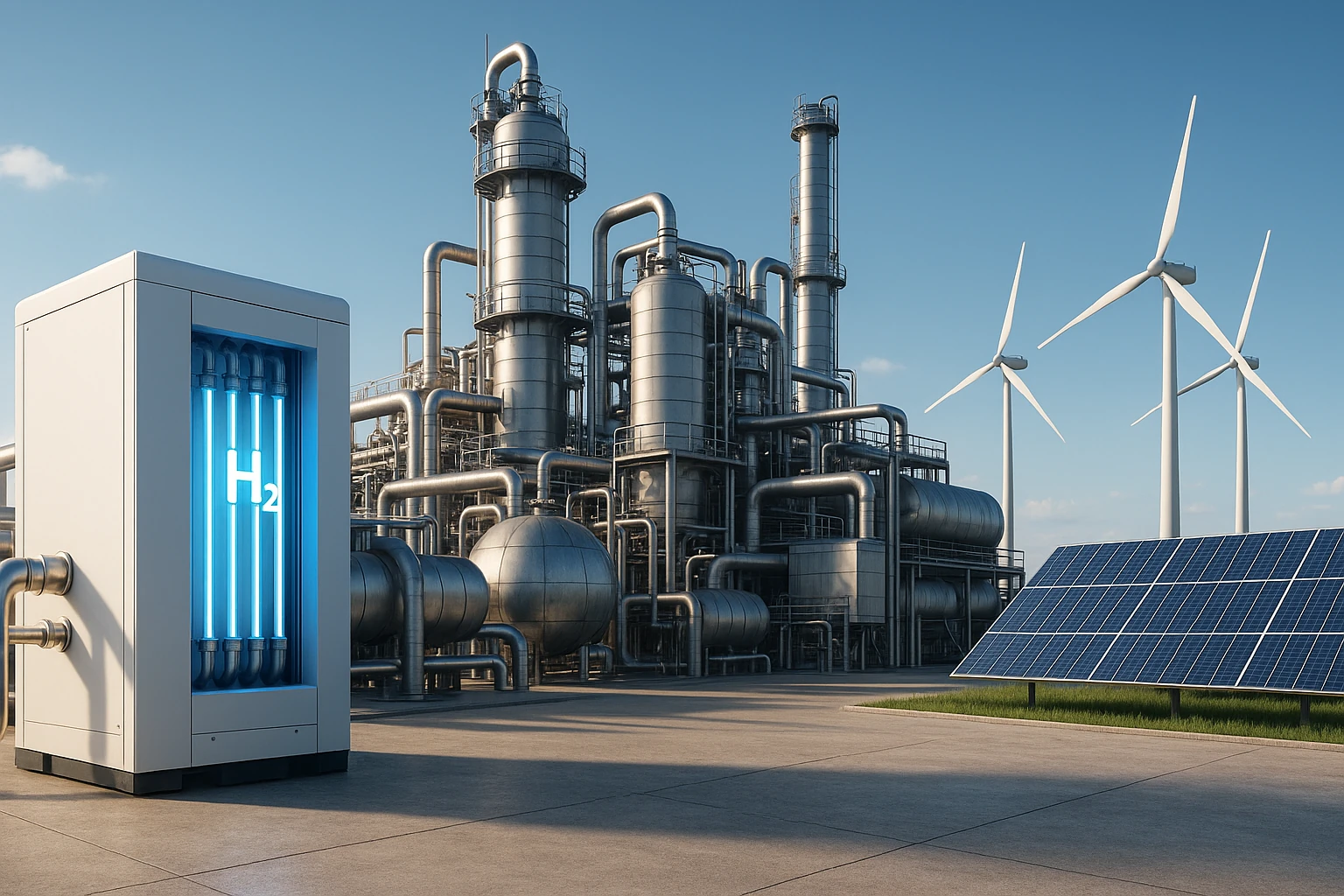
Hydrogen production methods
Hydrogen is produced using several methods, but the main ones are from natural gas, electrolysis of water, and industrial processes. Each method has different costs, emissions, and scalability.
Hydrogen production is the foundation of the entire hydrogen value chain. The way hydrogen is produced determines whether it is clean, low-carbon, or carbon-intensive.
Grey hydrogen
Grey hydrogen is the most widely used form today.
It is produced using natural gas through Steam Methane Reforming (SMR).
Key characteristics:
- Lowest production cost
- High carbon emissions
- Dominates current hydrogen supply
Although widely used, grey hydrogen is not sustainable due to its environmental impact.
Blue hydrogen
Blue hydrogen is similar to grey hydrogen but includes carbon capture.
Process:
- Produced from natural gas
- CO₂ emissions are captured and stored (CCS)
Key advantages:
- Lower emissions compared to grey hydrogen
- Uses existing infrastructure
- Transitional solution for energy systems
However, it still depends on fossil fuels.
Green hydrogen
Green hydrogen is produced using renewable energy through electrolysis.
Process:
- Electricity from solar or wind splits water into hydrogen and oxygen
Key benefits:
- Zero carbon emissions
- Fully sustainable
- Key to long-term energy transition
The main challenge is cost, as it is currently more expensive than other methods.
The future of hydrogen production
The future of hydrogen production will focus on:
- Scaling green hydrogen projects
- Reducing production costs
- Improving electrolyzer efficiency
- Integrating hydrogen with renewable energy systems
Over time, green hydrogen is expected to become the dominant production method.
FAQ
What are the different types of hydrogen?
Grey, blue, and green hydrogen are the main types, based on how they are produced.
What is green hydrogen?
Hydrogen produced using renewable energy through electrolysis, with no carbon emissions.
Which hydrogen production method is most sustainable?
Green hydrogen is the most sustainable because it has no direct carbon emissions.
Final Insight
Hydrogen production is not just a technical process—it is the defining factor of hydrogen’s role in the energy transition. The shift from grey to green hydrogen will determine how sustainable future energy systems become.
Management Perspective
“The future of hydrogen depends not on its use, but on how it is produced. Clean production is what transforms hydrogen into a true energy solution.”
— Dr. Roshandel