
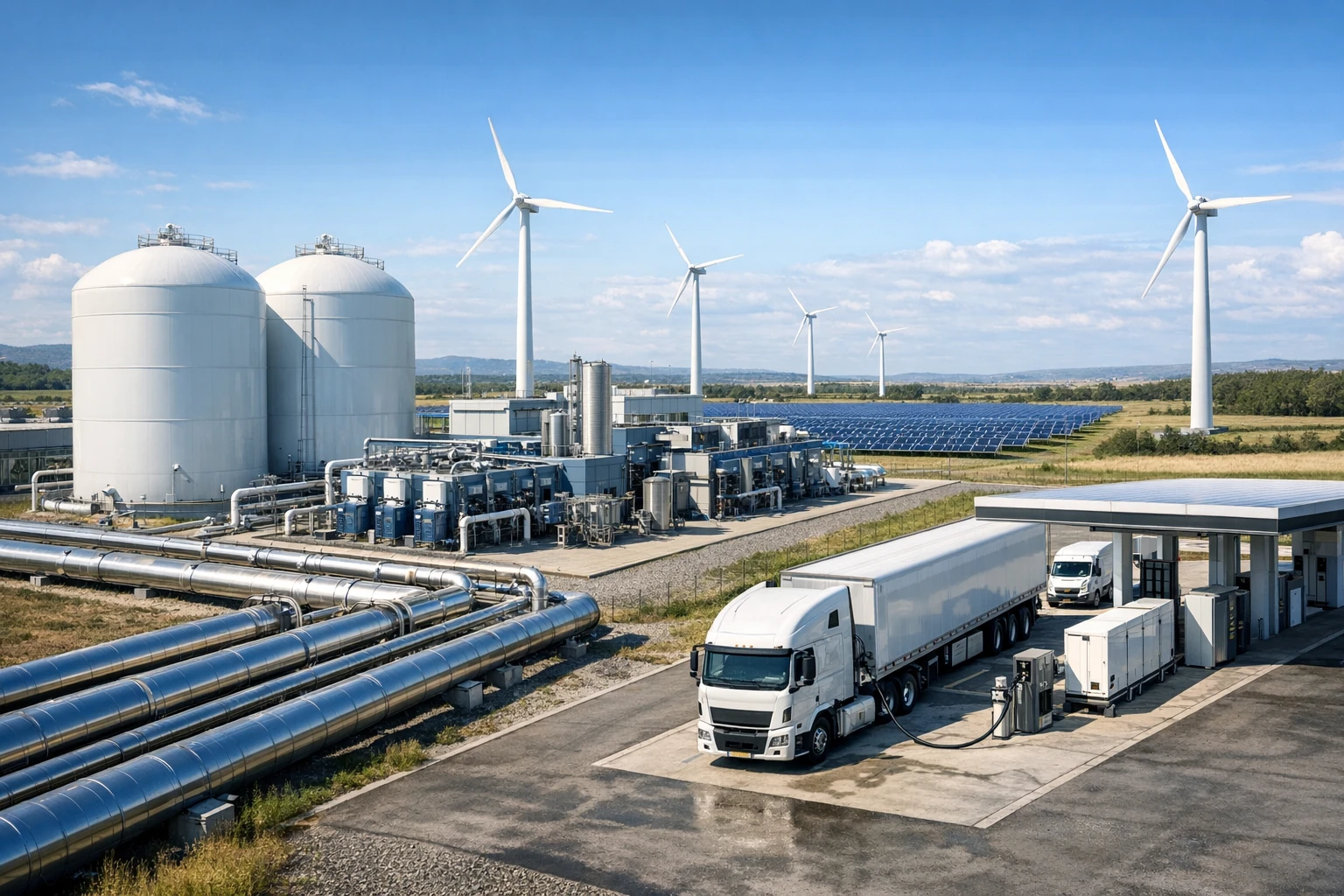
What hydrogen infrastructure includes
Hydrogen infrastructure includes all systems required to produce, store, transport, and deliver hydrogen from source to end-use.
Unlike traditional fuels, hydrogen requires a completely integrated value chain. This includes production facilities, storage systems, transport networks, and distribution points.
Without this infrastructure, hydrogen cannot scale as a global energy solution.
Hydrogen pipelines and transport
Transporting hydrogen is one of the biggest infrastructure challenges.
Main methods include:
- Dedicated hydrogen pipelines for large-scale distribution
- Blending hydrogen into existing natural gas pipelines (limited capacity)
- Truck transport using compressed hydrogen tanks
Pipelines are the most efficient solution for long-term, high-volume hydrogen distribution.
Hydrogen storage systems
Hydrogen storage is complex due to its low density.
Key storage methods:
- Compressed hydrogen (high-pressure tanks)
- Liquefied hydrogen (cryogenic storage)
- Underground storage (salt caverns)
Storage systems must balance safety, cost, and efficiency.
Refueling stations
Hydrogen refueling infrastructure is critical for transportation.
These stations are used for:
- Fuel cell vehicles
- Public transportation systems
- Heavy-duty transport
The expansion of refueling networks is essential for hydrogen mobility.
Challenges in building hydrogen infrastructure
Several challenges slow down infrastructure development:
- High capital costs
- Lack of global standards
- Safety and technical complexities
- Limited existing infrastructure
- Need for coordinated investment
Building hydrogen infrastructure requires collaboration between governments and private sectors.
FAQ
What infrastructure is needed for hydrogen energy?
Production plants, storage systems, pipelines, transport systems, and refueling stations.
Can hydrogen use existing natural gas pipelines?
In some cases, hydrogen can be blended into existing pipelines, but full conversion requires new infrastructure.
How is hydrogen stored and transported?
Through compressed gas, liquefied storage, pipelines, and specialized transport systems.
Final Insight
Hydrogen is not just a fuel—it is an infrastructure challenge. Its success depends on building a complete system that connects production to end use efficiently and safely.
Management Perspective
“Hydrogen will not scale through production alone. The real challenge—and opportunity—lies in building the infrastructure that connects the entire value chain.”
— Dr. Roshandel